
Thailand's Double Revolution: How a 400 Billion Baht Plan Could Transform Agriculture and Energy Forever
Latest World Bank & NESDC research reveals Thailand faces a critical economic crossroads — agricultural and energy reforms must happen simultaneously
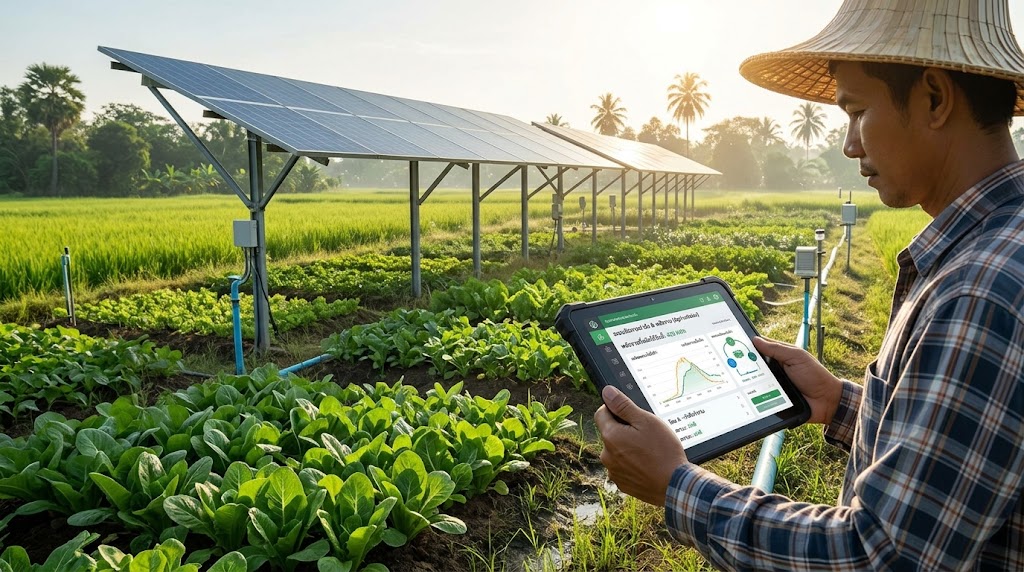
Thailand stands at a critical economic crossroads: one path leads to modernizing agriculture, another to green energy transition. But these are not separate choices — they are the same answer to the same problem.
“Without agricultural productivity reform and a rapid green energy transition, Thailand will face severe economic bottlenecks.” — World Bank & NESDC
This research report synthesizes the latest analysis from the World Bank, Thailand’s National Economic and Social Development Council (NESDC), and current government policies to help farmers and entrepreneurs understand why this transformation matters and how it will affect the lives of every Thai person.
📄 Download the Full Research Report
For those who want in-depth analysis, detailed comparison tables, and complete references:
⬇️ Download PDF: Research Report — Thailand Agricultural & Energy Reforms
File size: ~138 KB · Format: PDF · Language: English
Overview: The Link Between Agriculture and Energy
Both sectors face problems originating from the same root cause — an economy dependent on resource-intensive practices that have persisted for too long:
| Sector | Key Problem | Risk |
|---|---|---|
| Agriculture | Low productivity, frequent droughts and floods, stagnant income | Declining farmer income, younger generations abandoning farming |
| Energy | Dependence on oil and coal, high electricity costs, Oil Fuel Fund deficit exceeding 100 billion Baht | High cost of living, businesses becoming uncompetitive |
1. Agricultural Reform: From Experience-Based Farming to Digital Agriculture
🌾 The Ministry of Agriculture’s 9-Point Policy Framework
The Thai government has announced a 9-point policy framework with clear goals:
- Make Thailand a “Global Food Hub”
- Triple farmers’ incomes within 4 years
Four key policies that directly impact farmers:
1.1 Digital Transformation of Agricultural Data
Using Big Data + AI for crop planning instead of “guessing” what to plant this year. The system analyzes market price data, historical weather patterns, and consumer behavior.
1.2 Comprehensive Crop Insurance System
Moving from slow, inadequate compensation to real-time damage assessment using Satellite Imagery + IoT.
1.3 Integrated Land and Water Management
Solving recurring flood problems through Smart Water Management — early warning systems + Water Accounting that measures groundwater levels in every region.
1.4 Promotion of High-Value Agricultural Products
Shifting away from supporting low-margin rice as the primary crop toward promoting Organic vegetables, Premium fruits, herbs, and value-added food exports.
🌡️ Climate Pressure: Carbon Tracking is Becoming Essential
NESDC highlights:
- High energy demand in agriculture (irrigation pumps, processing, transportation) drives up food costs
- Thailand needs a Greenhouse Gas Emission Traceability System across the entire food supply chain
- This means farmers who can prove their farms are “climate-friendly” will get better prices — because global markets are increasingly demanding Carbon Credits
2. The Energy Crisis: 400 Billion Baht for a Green Future
⚡ The 400-Billion-Baht Plan Toward Green Energy
The government approved a 400-billion-Baht Royal Decree divided into two phases:
| Phase | Budget | Target |
|---|---|---|
| Short-term | 200 Billion Baht | Immediate relief: household electricity subsidies, Oil Fuel Fund crisis management |
| Long-term | 200 Billion Baht | EV infrastructure, renewable energy, energy storage systems |
🌞 Target 2037: 51% Green Energy
The Electricity Generating Authority of Thailand (EGAT) plan:
- Generate 51% of electricity from renewable sources by 2037
- Decommission 8,000 MW of old coal and gas power plants
- Add 50,000 MW of new solar, wind, and hydro capacity
- Install 14,000 MW of Battery Energy Storage Systems (BESS) to manage intermittent renewable generation
⛽ Oil Fuel Fund: A 100-Billion-Baht Deficit to Solve
- The national Oil Fuel Fund has accumulated losses exceeding 100 billion Baht
- The Energy Ministry is pushing to restructure energy prices to reflect true market costs
- The key question: will oil and electricity prices go down or stop rising too fast? The answer is we need Smart Grid + renewable energy to reduce costs
3. Where Agriculture Meets Energy: What Farmers Need to Know
The most important finding: reforms in both sectors are not separate — they create mutual opportunities.
🌽 Biofuel: What Cassava, Sugarcane, and Palm Oil Farmers Gain
The government is using energy pricing mechanisms to support farmers:
- Reduced excise taxes on E20 and B20 → lower pump prices → consumers use more → demand for cassava, sugarcane, and palm oil increases
- Biofuel promotion campaigns → reduce oil imports → money stays in the Thai economy
For farmers: This is a guaranteed new market that will buy your produce — not just the food market, but the energy market too.
☀️ Agrivoltaics: Growing Crops + Generating Electricity on the Same Land
Agrivoltaics involves installing solar panels above or between agricultural plots, offering multiple benefits:
| Aspect | Benefit |
|---|---|
| Income | Farmers earn from two sources: selling crops + selling electricity |
| Climate | Solar panels provide shade, reducing temperature below by 3-5°C → crops grow better (especially shade-loving vegetables) |
| Water | Shade reduces soil evaporation → saves 20-30% water |
| Soil | Reduced direct UV exposure → soil doesn’t dry out as fast, prevents soil acidification |
Studies from Japan (Chiba University), France (INRAE), and Australia (University of Queensland) show Agrivoltaics can increase per-rai revenue by 30-60% compared to farming alone.
4. Three Steps Every Thai Farmer Should Take
Based on all this data, Thai farmers should begin:
🔬 Step 1: Systematically Collect Farm Data
Install IoT sensors to measure temperature, humidity, light, soil, and water — this data is an asset that can be used for bank loans and Carbon Credits in the future.
⚡ Step 2: Install Solar Panels on Agricultural Land
Start with a small off-grid system (water pumps, greenhouse lighting) then expand to grid-tie to sell electricity back to the grid.
🌱 Step 3: Participate in the Carbon Credit System
With IoT data + Solar + low-carbon farming methods, farmers can sell Carbon Credits on global markets (currently ~$5-30/ton CO₂).
Conclusion
Thailand is facing one of the most important turning points in its history. Agricultural and energy reforms must happen simultaneously — not one or the other.
For farmers, this is not a threat but the greatest opportunity in 50 years:
- Biofuel markets will buy your produce at good prices
- Agrivoltaics will generate electricity income from the same land
- Carbon Credits will create new revenue from “saving the planet”
- Digital Farming will reduce costs and increase yields
At KoMoMi, we support Thai farmers to seize these opportunities with accessible IoT, AI, and energy technologies.
“Farmers don’t need to change careers — they need to change how they work, from traditional farming to intelligent multi-income farming on the same land.” — KoMoMi Research Team
References
📺 Reference Video: World Bank on Agricultural Reform
Or watch directly: https://www.youtube.com/watch?v=WsJanmdTKvY
📄 Full Research Report (PDF)
⬇️ Download PDF: Research Report — Thailand Agricultural & Energy Reforms
📄 Reports and Policy References
- World Bank — IMF/World Bank Group Annual Meetings 2025: Recommendations for Thailand Agricultural Reform
- NESDC (National Economic and Social Development Council) — Carbon Emission Traceability Report for Agriculture and Food Sector
- Ministry of Agriculture and Cooperatives — 9-Point Agricultural Policy Framework (2025)
- Royal Decree: 400-Billion-Baht Borrowing — For Energy Transition (January 2025)
- Electricity Generating Authority of Thailand (EGAT) — Power Development Plan 2024-2037 (PDP 2024)
- Ministry of Energy — Oil Fuel Fund Restructuring Report (2024)
- Biofuel Policy (E20/B20) — Excise tax measures and promotional campaigns
- Agrivoltaics Research — Japan (Chiba University), France (INRAE), Australia (University of Queensland)